
Our Blog

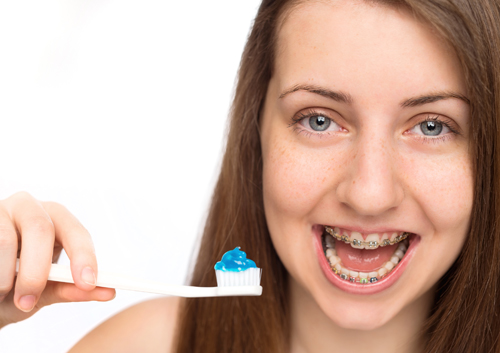
Brushing with Braces: How to Keep a Clean Mouth

August 23rd, 2023

A clean mouth is a happy mouth. And when Dr. Daniel Grob and our staff see you have a clean mouth, we are happy too. Of course, all of this should make you happy because you’re the one preventing sneaky little food bits from getting trapped under the wires of your braces.

Still, you need to be thorough with your brushing. When you have braces, you’re playing a game of hide-and-go-seek with everything you eat. Here are five tips to keep your mouth (and us) happy.

  1. How is brushing with braces like geometry? It’s all about the angles. Brush the tops of your teeth and braces with your brush angled down. Brush the bottom of your teeth with the brush angled up. Pointy brushes, aka interproximal brushes, are good for reaching the tiny spots around braces.
  2. Brush after every meal. If those sneaky little food bits hide in your mouth for very long, they’ll turn into plaque. And plaque is a sign of a very unhappy mouth.
  3. Brush one tooth at a time for at least ten seconds, and pay close attention to the spots where your braces touch your teeth.
  4. Fluoride is your new BFF. Make sure your toothpaste and mouthwash contain this cavity-fighting ingredient.
  5. Braces are no excuse not to floss. In fact, saying you can’t floss because you have braces is like saying the dog ate your homework. Dr. Daniel Grob and our staff, like your geometry teacher, aren’t going to buy it. Be sure to floss after every meal.

Can I use mouthwash instead of flossing?

August 16th, 2023

While mouthwash goes a long way in improving your oral care, it is not a substitute for flossing. Mouthwashes and flossing provide different benefits that you should understand.

Mouthwash Benefits

Mouthwash comes in two categories. Some are considered cosmetic. This type of rinse provides temporary relief from bad breath and has a pleasant taste. These do not actually kill any bacteria.

Therapeutic mouthwashes provide the healthier benefits. These may contain different ingredients including fluoride or antimicrobial agents. This type is used to remove plaque buildup and reduce the potential for calculus formation. Therapeutic rinses can also help prevent cavities, bad breath, and gingivitis. In addition, Dr. Daniel Grob can prescribe special rinses to assist patients after periodontal surgery or other procedures.

Flossing Benefits

Flossing is what removes the plaque formation before it can harden and become calculus. While a rinse reduces buildup, only flossing will fully remove plaque, especially between teeth. The bristles on a toothbrush do not get between teeth completely. If plaque is not removed, it hardens into tartar or calculus. When this builds below the gum line, gum disease can start.

Types of Floss

Floss is available in a thin string form or a tape. It can be waxed or unwaxed. If you find flossing difficult, you might want to try a different type of floss. You can buy bulk floss in containers or purchase the disposable type with a plastic handle attached. This style can be easier for many individuals to use. Interdental picks are available for bridgework or other situations where regular floss cannot be used.

If you have questions regarding the best mouthwash or floss, or need tips for easier flossing, please ask our Peoria team for advice. We will be glad to give you solutions to help keep your mouth clean and healthy.

What is a palatal expander?

August 16th, 2023

If Dr. Daniel Grob and our team at Valley Orthodontic Group have recommended a palatal expander, you might be wondering what it is and how it will help you. A palatal expander is a small appliance fitted in your mouth to create a wider space in the upper jaw. It is often used when there is a problem with overcrowding of the teeth or when the upper and lower molars don’t fit together correctly. While it is most commonly used in children, some teens and adults may also need a palatal expander.

Reasons to get a palatal expander

There are several reasons you might need to get a palatal expander:

  • Insufficient room for permanent teeth currently erupting
  • Insufficient space for permanent teeth still developing which might need extraction in the future
  • A back crossbite with a narrow upper arch
  • A front crossbite with a narrow upper arch

How long will you need the palatal expander?

On average, patients have the palatal expander for four to seven months, although this is based on the individual and the amount of correction needed. Several months are needed to allow the bone to form and move to the desired width. It is not removable and must remain in the mouth for the entire time.

Does it prevent the necessity for braces?

The palatal expander doesn’t necessarily remove the need for braces in the future, but it can in some cases. Some people only need braces because of a crossbite or overcrowding of the teeth, which a palatal expander can help correct during childhood, when teeth are just beginning to erupt. However, others may eventually need braces if, once all their permanent teeth come in, they have grown in crookedly or with additional spaces between.

If you think your child could benefit from a palatal expander, or want to learn about your own orthodontic treatment options, please feel free to contact our Peoria office!

Power Chains

August 9th, 2023

By now, you’re very familiar with the basic building blocks of your braces. Brackets, wires, and ligatures are no mystery to you. But suddenly, you’re hearing a brand new term—“power chains.” What exactly are these power chains, and why does your orthodontist think you need them? Let’s see how power chains are *linked* to your orthodontic treatment.

  • First, why power chains?

They’re not really chains in the necklace or bike chain sense—in fact, they’re only very rarely made with metal. These chains are most often a string of O ring loops just like your elastic ligatures, attached in a row to resemble a chain.

Chain lengths are tailored to your specific needs. Dr. Daniel Grob will attach each individual loop in the chain around a single bracket, linking selected teeth together. Chains might stretch across a few teeth, several teeth, or your entire upper or lower arch.

  • Second, why power chains?

Because these chains are usually made of the same elastics that your ligatures, or bands, are made from, they want to hold their original shape. They will try to return to that original shape even as they are stretched between your brackets. As they contract, they help move your teeth together. 

Over time, just like an over-stretched rubber band, they lose their elasticity, and won’t work as effectively. That’s why you’ll probably get a new power chain whenever you come in to our Peoria office for an adjustment.

  • Third, why power chains?

This is the most important question. How can a power chain improve your smile?

Usually, power chains become part of your treatment after the first phase of alignment. They can be used to help align your teeth or correct your bite, but are most often used to close gaps between the teeth.

You might have a gap after a tooth has been extracted. Or, as your teeth move into their new positions, you might suddenly see noticeable spaces between them. Power chains move the teeth closer together to eliminate these gaps, and do it more quickly than brackets and wires alone can do.

  • How long will you need them?

This is something Dr. Daniel Grob will discuss with you. Whether it’s a matter of weeks or months, your treatment plan is designed to move your teeth into their best positions, and to do it carefully for a lasting, healthy alignment.

  • Power chain options

Depending on the size and spacing of your teeth and your treatment plan, these chains usually take one of three forms: closed/continuous, short, and long. The only difference is the distance between the rings.

We will choose the type of chain that’s best for your treatment. Your contribution is to personalize your power chain. Power chains come in a rainbow of colors, allowing you to mix and match. You can even coordinate with your ligatures if you have ties as well as chains. If your goal is to have your braces blend in, various shades of white, silver, or clear colors are available. Want to mix things up? Choose a different color with every adjustment.

  • Anything else?

You might experience some discomfort for the first few days with a new power chain, just as you might with any adjustment. Dr. Daniel Grob will have suggestions for making those first days as comfortable as possible.

Also, like brackets and ligatures, power chains can trap food particles, so be sure to follow our instructions for keeping your teeth and your braces their cleanest.

Now that you’re all caught up on what power chains are and what they can do for you, let’s mention one more benefit. This is a process where you can actually see the gaps between your teeth closing over the weeks you wear your power chains. Keep a selfie record of your progress as you create your beautiful, healthy smile. That’s an em*power*ing experience!

Dr. Daniel Grob
Dr. Jason Loop
25225 N Lake Pleasant Pkwy
Suite 1240

Peoria, AZ 85383
(623) 572-2683
invisalign the clear alternative to braces invisalign for teens the clear alternative to braces member american association of orthodontists american board of orthodontics american dental association